Tuesday, March 31, 2009

Tuesday, March 31, 2009


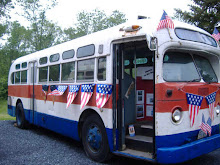
The oldest bus in our fleet, 1927 FAGEOL SAFETY COACH livery generic (brown and tan) with a destination sign that reads "1927" was built by Fageol Motors, which was founded in 1916 to manufacture motor trucks, farm tractors and automobiles in Oakland, CA.

In 1921 it became the first company to build a bus from the ground up. This new bus was called the "Safety Bus". The goal was to build a bus that wasn't prone to overturning when cornering. It had a wide track, and was lower to the ground to ensure the passengers' safety and ease of entry and exit. Following shortly on the heels of the success of the Safety Bus was the larger 22-seat "Safety Coach". The factory was located in Oakland, California. Unfortunately, the company did not make it through the depression of the early 1930s. It went into receivership and the bank assumed control and re-organized under the name Fageol Truck and Coach. The Fageol brothers left the company in 1927 to form a bus manufacturing company called the Twin Coach Company, which was located in Kent. Ohio.

Our beautiful Fageol has very unusual seats in it--see the picture to the right.

Monday, March 30, 2009

Monday, March 30, 2009


Valentine Diners began their nearly forty-year career in Wichita, Kansas--an idea born of the Great Depression. They were constructed as eight-to-ten-seat diners that one or two people could operate. If you were good at it--if you served good food at a fair price and kept your customers happy--you could make a successful business of a Valentine. In an industry where nearly all major diner manufacturers were on the East Coast, the Kansas creation managed to ship its little pre-fabs all across the country. Valentines could be found along major highways to attract travelers, in industrial areas to attract workers, and in small towns where they might be one of the only (if not the only) restaurants available.

The Valentine Diner at the Museum has been restored and is located across from the Bus Exhibit. It's name is the Flo-Inn Cafe, originally a "Kings-X" restaurant at the intersection of Emporia and Harry streets in Wichita. It was purchased from Jimmie King in either 1948 or 1950 by Florence Fortnoy, who operated it into the late 1980s.

In its last years as an active diner, it was only open for breakfast. Flo kept the restaurant open for the benefit of the regular morning customers who had become like family. A full basement was underneath the diner. Flo Fortnoy once remarked that when the Valentine company got into financial trouble, the salesmen were always trying to get her to buy a new model. The diner was restored by the Antique Automobile Club of America (AACA) Museum and is now on display there fulltime along with photographs and memorabilia from the original diner in use.

Sunday, March 29, 2009

Sunday, March 29, 2009


Today I'd like to talk about the Baran's Bus -- a 1945 Aerocoach Model P45/37.

Mastercraft models of this particular series were built in 1944 and 1945 at a time when most bus production was halted. 338 of this model were built in these two years and many of them saw line service with both Trailways and Greyhound. This one was sold to Robert Merrell, a small operator in New Jersey, as his No. 3. He used it in charter work and often leased it out to Royal Blue Coaches and Edwards Lakes to Sea System, both of which had similar coaches in their fleets (destination signs for both carriers are still on the sign rolls).

John Baran, owner of Baran's Transit Lines, Beaver Meadows, PA, bought this coach in the early 1970's and ran it in charter and some limited local line work until 1999, as the last "seated" Aerocoach in active service. He donated it to the Museum in 2003. ABC Bus, Camden, NJ, under the direction of its Board Chairman, Clancy Cornell, refurbished it for the Museum in March 2006.

Saturday, March 28, 2009

Saturday, March 28, 2009


We had heavy rain here in the Susquehanna Valley overnight and it brought to mind "what did people do when riding in a Fifth Avenue Coach Company open-top double decker bus"--so I went searching through our photographs and located this one--of a 1919 bus with the driver putting up what appears to be a portable canvas top! Not sure how well that would keep people out of the rain! I know that this was one problem the Fifth Avenue Coach Company had with its open-top double-deckers--fares went way down during inclement weather and they were not able to use them during the winter.

Friday, March 27, 2009

Friday, March 27, 2009

Well, we are back from New York and my Mother's funeral. Still having NY on my mind (and thank goodness for HOV lanes--otherwise we'd still be sitting in traffic on the Staten Island Expressway!), I thought I'd discuss NY City Transit's Vintage Bus Fleet.

While chronological gaps in their collection certainly exist, when displayed together publicly, it is a most impressive array of bus equipment. The bulk of the vintage fleet is made up of a wide variety of "new look" or fishbowl buses, so named for their sleeker design from the 1960s. These models featured much larger windows than their predecessors. Rounding out the collection are two models from the next generation of advanced design buses. First making their appearance in the early 1980s, many are still on the road today. This includes the "RTS", the most common workhorse of the NY City Transit buses in use over the past two decades.

Here's a quick rundown of the fleet:

Bus #303 - 1917 Fifth Avenue Coach open top double decker bus (used 1917-1930)
Bus #2124 - 1938 Fifth Avenue Coach Queen Mary double decker bus (used 1938-1953)
Bus #2969 - 1949 NYCTA GM 5101 - photographed in the classic TV series "The Honeymooners" (used 1949-1966)
Bus #3100 - 1956 GM 5106 Fifth Avenue Coach (used 1958-mid 1970s)
Bus #6259 - 1956 Mack C49DT (used 1956-1969)
Bus #7144 - 1957 GM 5106 (used 1957-1971)
Bus #9098 - 1958 GM 5106 (used 1958-1972)
Bus #100 - 1959 GM 5301 Fishbowl (used 1959-1973)
Bus #1059 - 1961 GM 5301 Fishbowl (used 1961-1981)
Bus #2151 - 1962 GM 5301 Fishbowl (used 1962-1982)
Bus #3758 - 1963 GM 5303 2nd Generation Fishbowl (used 1963-1982)
Bus #5117 - 1964 Flxible F2D6V-401-1 (used 1964-1983)
Bus #8466 - GM 5303 (used 1966-1990)
Bus #8928 - GM 5305A (used 1968-1984)
Bus #4727 - Flxible 111CC-D51 (used 1969-1988
Bus #5227 - GM "Blitz" 5305A (used 1971-1995
Bus #7340 - Flxible 53102-6-1 (used 1973-1990)
Bus #236 - Grumman 870 (used 1980-1984)
Bus #1201 - GM RTSII-04 (used 1981 - Present)

Tuesday, March 24, 2009

Tuesday, March 24, 2009


Still have New York on my mind--and while I do, there is no greater vision of New York City buses then their beautiful Queen Marys which were nicknamed after the Queen Mary Oceanliner that was popular at the time. These were the double-deck buses that ran mostly up/down Fifth Avenue and into the borough of Queens. They were owned and operated by the Fifth Avenue Coach Company until it was taken over by NY City Transit. The Transit Authority still owns a "Queen Mary" in their historic fleet.
Board Member, Oliver Ogden, has written a book on the Fifth Avenue Coach which will be available October 1, 2009. They are now available for pre-order through Amazon.

Monday, March 23, 2009

Monday, March 23, 2009

As we are headed to NY for my Mother's funeral on Wednesday and Thursday, I thought I would write about one of our newer acquisitions from the former Jamaica Bus Company. Sunday, January 29, 2006 marked a major turning point in private bus transportation when Jamaica Buses' operation to the communities the serviced terminated and the route were taken over by the Metropolitan Transit Authority. Jamaica Bus Lines operated 103 buses on four local and express lines that served 10 million riders per year across New York City. Jamaica was the sixth bus line that was transitioned to the MTA operation in 2005-2006. We were offered Jamacia Bus Lines 1972 GM T6H 5308-A and accepted it. Here's a brief history of the company:

In 1894, the Long Island Electric Railway was incorporated for the purpose of building and operating street railways in Queens County (at that time Queens County included all of present-day Nassau County), and the first route began operating in 1896 from the Kings County Elevated Railroad station at the Brooklyn city line to downtown Jamaica. In the following year service had been extended along present-day Guy R. Brewer Boulevard to Far Rockaway, and along Jamaica Avenue to 212th Street.

In 1899 the Long Island Electric was purchased by the New York & North Shore Railway Company, a subsidiary of the New York & Queens County Railway Company - then the largest street railway operator in Queens. However, the company eventually faltered. In 1902, the original route of the New York & North Shore (Flushing-to-Jamaica along present-day 164th Street) was sold at foreclosure to the New York & Queens County, and the New York & North Shore changed its name back to the Long Island Electric the following year.
The last section of track to be built by the company was a short one-mile extension from 212th Street to the city line on Hempstead Avenue at Belmont Park, this track was placed into service during 1904.

In 1906, August Belmont, president of the Interborough Rapid Transit Company and a director of the Long Island Rail Road, announced that he had acquired a controlling interest in the Long Island Electric; half of his interest in the company was transferred to the Interborough Rapid Transit, and the other half to the Long Island Consolidated Electric Companies, a subsidiary of the Long Island Rail Road.

Fire struck the company's car barn in 1924, and completely destroyed all the company's facilities. This loss, when combined with continuing annual operating losses and nonpayment to bondholders led to a foreclosure on the company that year. The company was sold at a bankruptcy sale in 1926 to American Communities Corporation, a corporation controlled by the Bank of Manhattan. Later that year the company's name was changed to Jamaica Central Railways.

In 1931, the City of New York announced a plan to widen Jamaica Avenue, and would require the company to spend thousands of dollars to relay its track in that street. Rather than undertaking this expensive project the company instead planned to motorize its Jamaica Avenue route, and substitute buses for the streetcars. A subsidiary, Jamaica Buses, Inc., was formed that year to operate buses on the motorized routes. The City of New York granted a franchise to Jamaica Buses, Inc. in 1933 in exchange for the surrender of all the parent company's trolley franchises. With the new bus franchise in hand, the company motorized all the routes in the latter part of the year.

Jamaica Buses experienced financial difficulties and the Mayor offered the Jamaica Buses franchise to Green Bus Lines if the company could act quickly to rescue the company from financial failure. The stockholders of Green Bus Lines agreed to purchase the company. By the 1970s, deferred maintenance had taken its toll on the City's rapid transit system, and additional demands were being made for express bus services between Queens and Manhattan. In response to these requests, Jamaica Buses initiated service an express route from southern Queens County.